How to Read DEXA Body Composition Results, Scan to Scan
To read DEXA body composition results, start with fat mass and lean mass, and compare each with your last scan, taken the same way on the same machine. In one study of lifters, a change had to beat about 2.1 kg (4.6 lb) of lean mass or 1.3 kg (2.9 lb) of fat. For muscle, watch your arms and legs.
On this page
- How to read DEXA body composition results: fat, lean, bone
- Changes under 2.1 kg of lean or 1.3 kg of fat can be noise
- Lean mass up 2.4 kg in 16 weeks: muscle or water?
- Book every DEXA scan under the same conditions
- How often to get a DEXA scan: 4 months or longer
- Visceral fat moves slowly, and bone rows are for a doctor
- FAQ
How to read DEXA body composition results: fat, lean, bone
A DEXA scan splits your body weight into three parts, and the three add up to what you weigh:
- Fat mass. All your fat, in kilograms or pounds. Body fat percentage is this number divided by your total weight.
- Lean mass. Everything that isn't fat or bone. That's your muscle, but also your organs, skin, water, the glycogen stored in your muscles and whatever is in your gut.
- Bone mineral content (BMC). The mineral in your skeleton, a few kilograms. It changes slowly, so you can skim it.
Below the totals, the report splits each part by region: arms, legs, trunk and head. The lean mass in your arms and legs together is called appendicular lean mass. It's mostly muscle, with no organs mixed in, so it's the closest thing on the sheet to a muscle reading.
The trunk is the opposite. Its lean mass includes your organs and your gut contents, and it swings the most from day to day (Zemski et al., 2019).
Many reports also add percentile bars that compare you with other people. That's interesting once, but it can't tell you whether you're improving. Only your own last scan can.
On your first scan, write down your fat mass, total lean mass and the lean mass of your arms and legs. That's your baseline for every scan after it.
Changes under 2.1 kg of lean or 1.3 kg of fat can be noise
No two scans match exactly. Your hydration, your last meal and the glycogen in your muscles shift from day to day, and the machine adds a little error of its own.
The number that sorts noise from change is the least significant change (LSC). It's the smallest difference between two scans you can trust with 95% confidence, and it equals 2.77 times the precision error of repeat scans (Hind et al., 2018).
The most useful margins for lifters come from a study of 21 adults with at least a year of steady resistance training (Zemski et al., 2019). Each was scanned twice one morning and once more a day apart. Every scan was early, fasted, rested and on the same Hologic scanner.
The scans a day apart are closer to real life, because they include your body's own swing from one day to the next. These are the margins they produced:
| Number | A change must beat |
|---|---|
| Total lean mass | 2.1 kg (4.6 lb) |
| Trunk lean mass | 1.9 kg (4.2 lb) |
| Legs lean mass, both legs | 1.1 kg (2.4 lb) |
| Arms lean mass, both arms | 0.4 kg (0.9 lb) |
| Total fat mass | 1.3 kg (2.9 lb) |
| Body weight | 1.1 kg (2.4 lb) |
| Visceral fat | About 20% of the reading |
The standard method, which the International Society for Clinical Densitometry recommends, uses two scans on the same day (Zemski et al., 2019). Here it gave much tighter margins, 0.6 kg (1.3 lb) for lean mass and 0.7 kg (1.5 lb) for fat, because it leaves out your body's daily swing.
Quick check: with the same scanner and routine, a lean change past 2.1 kg (4.6 lb) or a fat change past 1.3 kg (2.9 lb) is likely real. Anything smaller needs the next scan to move the same way.
Your own margins may be wider. These came from one scanner under strict conditions, and scanners from different makers, or even different models, can read the same body differently (Hind et al., 2018). If your clinic gives you its own LSC, use that.
Lean mass up 2.4 kg in 16 weeks: muscle or water?
Here are two DEXA scans of the same lifter, 16 weeks apart, on the same machine at the same time of morning. The numbers are an example. Scan 2 happened on the Monday after a high-carb weekend.
| Number (kg) | Week 0 | Week 16 | Change | Must beat |
|---|---|---|---|---|
| Weight | 84.0 | 85.6 | +1.6 | 1.1 |
| Fat mass | 16.8 | 16.0 | −0.8 | 1.3 |
| Body fat | 20.0% | 18.7% | −1.3 points | |
| Lean mass | 63.8 | 66.2 | +2.4 | 2.1 |
| Trunk lean | 30.4 | 32.0 | +1.6 | 1.9 |
| Legs lean | 21.4 | 22.0 | +0.6 | 1.1 |
| Arms lean | 8.6 | 8.8 | +0.2 | 0.4 |
Read it in five steps:
- Check the total. Lean mass rose 2.4 kg (5.3 lb), past its 2.1 kg margin. On its own, that reads like 16 weeks of solid muscle gain.
- Find where it went. Of the 2.4 kg, 1.6 kg (3.5 lb) sits in the trunk, the noisiest region, and that's still under the trunk's 1.9 kg margin. Arms and legs gained 0.8 kg (1.8 lb) between them, and neither beat its own margin.
- Check what changed before the scan. In a study of 18 trained male cyclists, two days of deliberate carb loading raised DEXA's lean mass reading by 2% (Bone et al., 2017). That was 12 g of carbs per kg of body weight a day, and adding creatine loading made it 3%. Without creatine, leg lean mass rose about 2.6%.
- Subtract the likely water and glycogen. On this lifter, 2% of total lean is 1.3 kg (2.9 lb) and 2.6% of the legs is 0.6 kg (1.3 lb), the whole leg gain (our arithmetic). A high-carb weekend is a smaller dose than that study's, so treat these as a ceiling. So water and glycogen could explain about half the jump, 1.3 of the 2.4 kg.
- Read fat on its own. Down 0.8 kg (1.8 lb), under the 1.3 kg margin. A good start, not yet proof.
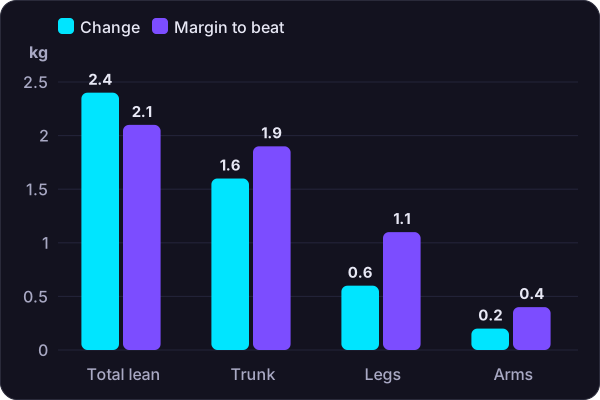
So the gain is promising, but glycogen and water could account for much of it, in the legs too. Book the next scan after a normal weekend. If your arms and legs keep climbing past their margins on scans prepared the same way, that's most likely muscle.
Your training log is the tiebreaker, and a tape measure on your arms and thighs is a cheap second one (how to track body measurements). Lean mass that comes from muscle usually shows up as heavier lifts or more reps, so check your main lifts over the same 16 weeks. See how to track progressive overload and how to log workouts.
Book every DEXA scan under the same conditions
The margins above already assume a strict routine. Skip it and your swing gets bigger. Researchers who scan athletes use one like this (Nana et al., 2015), and you can copy it:
- Same scanner. The same machine at the same clinic, every time.
- Early morning, before you eat. In a study of 31 active young adults, breakfast and a normal day of activity both pushed lean mass readings up (Nana et al., 2012). If you must eat, another study found DEXA held up while that morning's food and drink stayed under 500 g (Kerr et al., 2017).
- Rested. No hard training the day before. In the cyclist study, leg lean mass read 1.4% lower after an exercise protocol that drained muscle glycogen (Bone et al., 2017).
- Same food and supplements. Eat your normal diet in the days before, and don't start or stop creatine between scans. Creatine loading raised total body water by 1.4% in the same study.
- Bladder empty, light clothes, no metal. Go to the bathroom first, and leave off watches, zips and underwires (UC Davis Sports Medicine).
- Same position on the table. Ask the technician to set you up the same way each time.
Common mistake: booking the follow-up for the Monday after a weekend of pizza and pasta. The extra glycogen and water can read as new lean mass, and the "gain" may vanish on the next scan.
How often to get a DEXA scan: 4 months or longer
Space your scans so a real change has time to clear the margin. One review puts 10 weeks of lifting at about 1.4 kg (3.1 lb) of lean weight gained and 1.8 kg (4.0 lb) of fat lost (Westcott, 2012). It's a single-author review that mostly describes people starting or restarting training, so treat it as a ballpark.
At that pace, fat clears its 1.3 kg margin in about 7 weeks, while lean mass needs about 15 weeks to clear 2.1 kg (our arithmetic).
So if you're new to lifting or coming back to it, wait about 4 months between scans for lean mass. If you've trained for years, gains come slower, so wait longer. If fat is the number you watch, about 2 months is enough at that pace. Monthly scans will mostly show changes inside the margins.
The radiation dose is small. One review gives about 2 microsieverts for a standard total-body scan on one common scanner (Hind et al., 2018). One day of natural background radiation in the UK is 5 to 8.
Visceral fat moves slowly, and bone rows are for a doctor
- Visceral fat (VAT). The fat inside your abdomen, around your organs, shown as a mass, area or volume. In the lifter study, it had to change by about 20% to beat the noise (Zemski et al., 2019), so read it as a slow trend. If your report flags it, ask a doctor what it means for your health.
- Android and gynoid fat. The fat over your belly (android) and over your hips and upper thighs (gynoid), plus the ratio between them. In the same study, android fat and gynoid fat each had to change by about 10% to count.
- FFMI. Your fat-free mass divided by your height squared, so tall and short lifters can be compared. It moves with water and glycogen too.
- Bone density, T-score and Z-score. A T-score compares your bones with a healthy young adult's, and a Z-score with people your age. These are a medical reading. UC Davis Sports Medicine notes that the bone result on its body composition scan isn't a diagnostic bone-density test. If your report flags your bones, take it to a doctor.
If you also get InBody scans, keep the two machines apart. In a study of 1,000 US Marines, the InBody 770 read body fat lower than DEXA on average (Potter et al., 2025). The average gap was about 4 percentage points in men and 3 in women, and it varied from person to person.
How to read InBody results covers the InBody side.
Each scan's detail view in Lifter Log shows FFMI, visceral fat, lean mass per limb and a left-right balance card. The body-scan section shows what else it reads.