How to Load a Barbell: Plates Per Side, Step by Step
To load a barbell, subtract the bar's weight from your target, halve what is left, and build that weight on each side with the heaviest plates closest to the center. For 87.5 kg on a 20 kg bar, each side holds 33.75 kg: a 20, a 10, a 2.5 and a 1.25. Then fit collars.
On this page
How to load a barbell in four steps
- Know the bar. Check your bar's label, or ask the gym. The examples here use a 20 kg bar, or 45 lb in the pounds example. Bars differ, so use the weight on yours.
- Find the weight per side. Target minus the bar, divided by two. For 87.5 kg: 87.5 minus 20 is 67.5, and half of that is 33.75 kg.
- Pick plates for one side. Take the biggest plate that fits, then the next, until you reach the number. 33.75 is 20 + 10 + 2.5 + 1.25.
- Load the heaviest first, then match the other side. Slide the 20 kg plate on one end, then the matching one on the other. Repeat with the 10, the 2.5 and the 1.25, then secure both ends with collars.
Add the plates on both sides (33.75 × 2 = 67.5), then add the bar (67.5 + 20 = 87.5). If that is not your target, you have a plate wrong.
Plate math: subtract the bar, then halve
Halving is the step to check. The weight you want is the whole bar. The plates you pick are for one end. Here are six targets on a 20 kg bar, with the plates for each side.
| Target (kg) | Minus bar, halved | Plates per side |
|---|---|---|
| 60 | (60 − 20) ÷ 2 = 20 | 20 |
| 70 | (70 − 20) ÷ 2 = 25 | 20 + 5 |
| 80 | (80 − 20) ÷ 2 = 30 | 20 + 10 |
| 87.5 | (87.5 − 20) ÷ 2 = 33.75 | 20 + 10 + 2.5 + 1.25 |
| 100 | (100 − 20) ÷ 2 = 40 | 20 + 20 |
| 102.5 | (102.5 − 20) ÷ 2 = 41.25 | 20 + 20 + 1.25 |
In pounds, the method is the same. On a 45 lb bar, 185 lb leaves 140 lb, half of that is 70 lb per side, and 70 is a 45 and a 25. If your bar is not 45 lb, swap in its weight.
Common mistake: Loading the full target on each end. If you want 100 kg and put 100 kg of plates on each side, the bar holds 220 kg. Halve first.
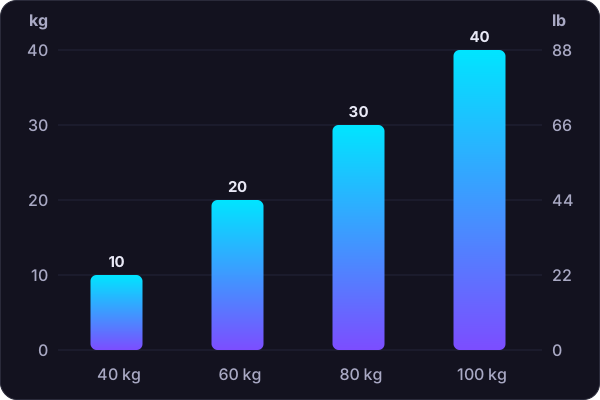
Warm-up sets are the same math repeated. Say your sets are 40, 60, 80 and 100 kg. Each side holds 10, 20, 30 and 40 kg (about 22, 44, 66 and 88 lb). Between sets, you only change the plates by the difference: from 60 to 80 kg, add 10 kg to each side.
Want it done for you before you walk to the rack? The plate calculator takes your bar and the plates your gym has and shows each side.
Put the heaviest plates closest to the center
The big plates go on first, against the shoulder of the sleeve. The smaller plates stack outside them, in descending weight. The IPF Technical Rules Book (January 2024 edition, hosted by a national federation) says discs are loaded "heavier discs innermost", so referees can read each weight.
You are not refereed in the gym, but the order still helps. Keeping the order the same on both ends also makes a mismatch easy to spot from across the room.
The same rulebook has a face rule: the first and heaviest disc goes on face in, and the others go on face out. That is a competition detail. In your own training, load the labels so you can read them.
Quick check: Look down the bar from one end. The plates should step down in size and match the other side plate for plate.
Load both ends evenly, then fit collars
Add one plate to one end, then the matching plate to the other, and repeat. Alternating keeps both ends matched, and a missing plate on one side is easy to spot.
Collars lock the plates to the sleeve.
The same 2024 edition requires collars on every lift in competition, and they must weigh 2.5 kg each. It also sets the bar and collars together at 25 kg, so two 2.5 kg collars leave 20 kg for the bar. If your collars have a weight marked on them, add it to the bar in your math.
- Fit them tight to the outer plate.
- Unload the same way you loaded. Remove one plate from an end, then the matching one from the other.
Log the load the way you loaded it
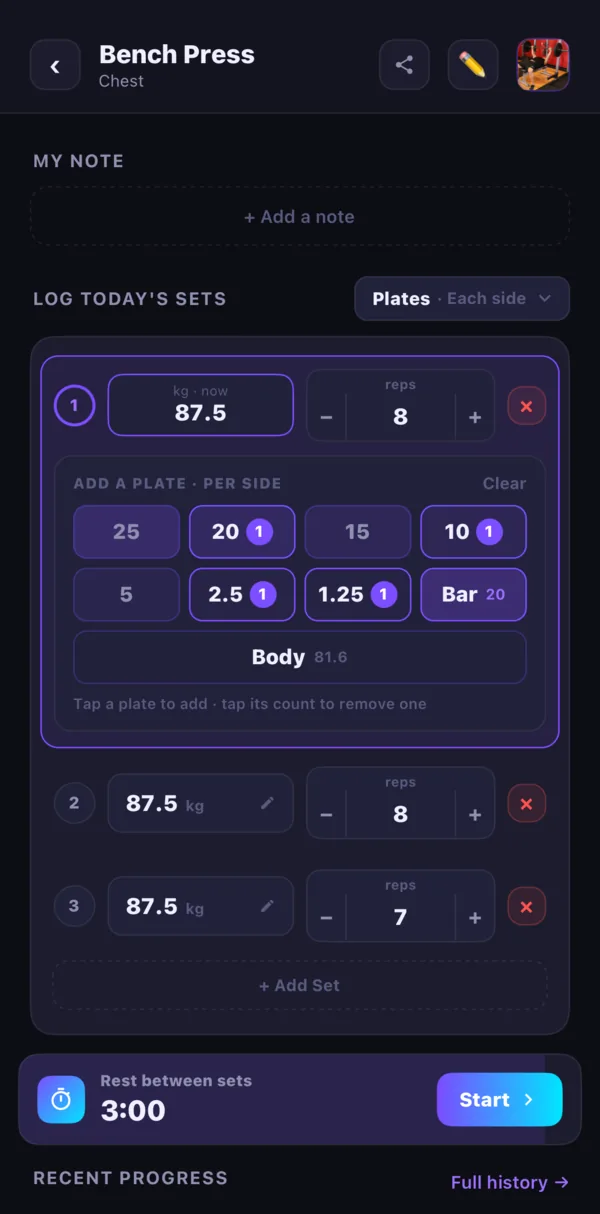
The plates you slide on are not always the number you want in your log. Writing 33.75 per side when you meant 87.5 total makes next week's comparison useless. Pick one form and keep it, as the workout logging guide recommends.
In Lifter Log you can enter a set by number or by plates, and as a total or per side. The per-side choice doubles the number and adds the bar once. You can also add a barbell weight, and the app remembers your choice for each exercise.
When your plates do not make the number
Your smallest plate sets your smallest jump. With 1.25 kg as the lightest, the total changes in steps of 2.5 kg (two plates, one per side). A target of 91 kg is not loadable: 35 kg per side gives 90 kg, and 36.25 gives 92.5 kg. Round to the one you can load.
If your plan says add a little each session, a 2.5 kg step is what you have to work with. The double progression guide covers adding reps before you add weight. Percentages from a 1RM percentage chart work the same way: round to what the plates allow.