Deload Week: How Often, How Long and What to Cut
A deload week is a planned stretch of lighter training. In a survey of 246 strength and physique athletes, a deload lasted about 6 days and came every 5.6 weeks, with fewer sets and lighter, easier work. In a made-up example below, weekly bench sets drop from 12 at 80 kg to 6 at 70 kg.
On this page
Athletes deload about every 5 to 6 weeks, for about a week
A 2023 panel of expert coaches (34 answered the first round, 21 finished the third) defined a deload as a period of reduced training stress. Its aim is to ease fatigue and help recovery (Bell et al., 2023). That is consensus opinion, not a trial result.
A later survey asked 246 competitive athletes what they actually do (Rogerson et al., 2024). Most were powerlifters, and they answered for themselves, so read the numbers as habits.
- How long: 6.4 days on average, give or take 1.7.
- How often: every 5.6 weeks on average, give or take 2.3, with answers from 1 to 12 weeks.
- Why: managing fatigue and energy were the main reasons.
Common mistake: Treating the 5.6-week average as a law. The spread is wide, and 65% of these athletes said they felt they could progress without deloading at all.
What to cut: effort and load first, then sets, not sessions
Most surveyed athletes kept the same sessions and exercises and turned down the dose. The table shows the share who said they would cut each part, and the share who would leave it alone.
| What athletes changed in a deload | Cut it | Left it alone |
|---|---|---|
| Sets per week | 78.9% | 17.9% |
| Reps per set | 52.8% | 30.9% |
| Load on big lifts | 83.7% | 11.4% |
| Load on single-joint lifts | 60.2% | 33.3% |
| Effort on big lifts (how close to failure) | 84.9% | 6.1% |
| Sessions per week | 32.9% | 63.0% |
| Number of big lifts | 26.4% | 70.3% |
Read it as a pattern. Fewer sets, a lighter bar and stopping further from failure were the common moves. Keeping your schedule and your lifts was the common choice. Rows do not sum to 100%: the rest increased it or answered other. The survey does not say how much to cut, so the next section uses a worked example, not a research figure.
A deload week example: a 6-week bench block
This is a made-up log to show the arithmetic. The lifter benches twice a week at 80 kg (176 lb) for 8 reps and adds sets over the first five weeks.
| Week | Sets per session | Weekly sets | Load and reps |
|---|---|---|---|
| 1 | 4 | 8 | 80 kg × 8 |
| 2 | 4 | 8 | 80 kg × 8 |
| 3 | 5 | 10 | 80 kg × 8 |
| 4 | 5 | 10 | 80 kg × 8 |
| 5 | 6 | 12 | 80 kg × 8 |
| 6 (deload) | 3 | 6 | 70 kg (154 lb) × 8 |
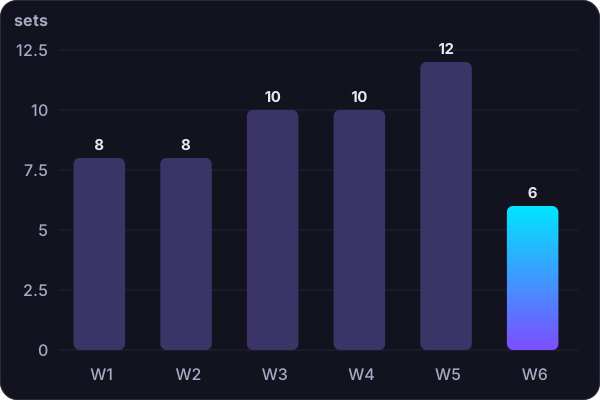
Week 5 adds up to 12 sets × 8 reps × 80 kg, or 7,680 kg of tonnage. The deload week is 6 sets × 8 reps × 70 kg, or 3,360 kg. That is 44% of week 5: half the sets and a bar 10 kg lighter, with the same two sessions and the same exercise.
The eight reps at 70 kg should feel easy, with several more in the tank. That matches the survey, where most athletes lowered both load and effort.
Coach's tip: After the deload, compare week 7 with week 5, not with week 6. A lighter week resets the block and sets no new baseline. The training volume guide covers why.
When to deload: the calendar or what your log shows
Athletes in the survey used both. Nearly half (47.2%) planned deloads in advance, 13.4% only deloaded reactively, and 39.4% did both. When asked what triggers one, they gave three main answers:
- The program says so: 65.4%.
- Feeling beat up (soreness, achy joints): 62.6%.
- Performance stalled or dropped: 54.1%.
The third trigger is the one a log can answer. One stalled lift is usually a plateau to fix with reps, rest or sets. A deload fits better when several lifts go flat or slip together.
A working rule, not a research finding: top-set weight and total reps flat or falling on most of your main lifts for two to three sessions in a row.
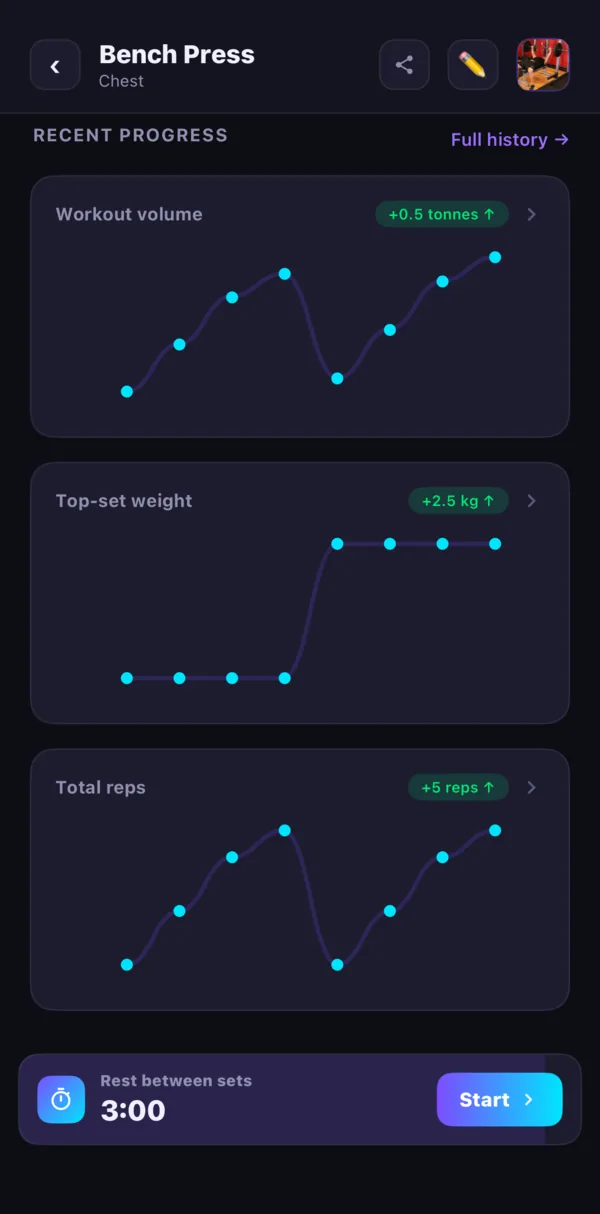
If you do not follow a program, set your own date. Count five or six weeks from your last easy week and glance at the charts before you commit.
The evidence for deloading is thin
The trial cited here tested a full week off, not the survey's version of a deload with reduced sets and load. Thirty-nine resistance-trained adults followed a high-volume 9-week program. One group stopped lifting for week 5, and the other trained straight through (Coleman et al., 2024).
Lower-body muscle size, quad endurance and power did not differ between groups. The group that trained straight through gained more lower-body strength and scored slightly higher on a readiness-to-train questionnaire. The upper-body sessions were unsupervised. The authors concluded that a midpoint deload appears to reduce lower-body strength gains.
So a deload is a judgment call. For a full week off, the one trial here found no extra muscle growth and a lower-body strength cost. It did not test a reduced-set deload.
Run one in four steps
- Pick the trigger. A date you set in advance, or the log showing several flat lifts.
- Lower the weight and stay far from failure. Aim to finish every set with reps to spare.
- Cut sets by about half. The half comes from the example above. Keep the same sessions and exercises.
- Log it and return to your pre-deload numbers. Compare next week with week 5.
If a joint hurts, see a qualified professional. A lighter week is not a treatment. For how many sets to run once you are back, see how many sets per muscle group per week, and for adding reps before weight, double progression.