How to Break a Strength Plateau: Fix It From Your Log
To break a strength plateau, first confirm it: three sessions with no new best weight, rep or total reps. Then change one thing at a time: add a rep before weight, rest longer, add a set, deload last. In the example log, a bench stuck at 85 kg (187 lb) gained reps over S6 to S8, then weight at S9.
On this page
A plateau is three sessions with no new best
One flat week is noise. Sleep, stress and a bad warm-up all show up in a single session. The rule of thumb we use: three sessions in a row with no new best weight, rep or total reps on that lift is a plateau. It is a working rule, not a research finding.
Here is an example log for a bench press at 85 kg (187 lb). The numbers are made up to show the pattern. Total reps are the sum across the three working sets.
| Session | Sets at 85 kg | Total reps | Best set |
|---|---|---|---|
| S1 | 5, 5, 4 | 14 | 85 kg × 5 |
| S2 | 5, 5, 5 | 15 | 85 kg × 5 |
| S3 | 5, 5, 4 | 14 | 85 kg × 5 |
| S4 | 5, 4, 4 | 13 | 85 kg × 5 |
| S5 | 5, 5, 4 | 14 | 85 kg × 5 |
S2 set the best total, 15 reps. S3, S4 and S5 all failed to beat it, so S5 is where this lifter confirms a plateau.
Common mistake: Calling a lift stuck because progress got slower. The American College of Sports Medicine notes that nobody can improve at the same rate for years (ACSM, 2009). Slow is normal. Flat for three sessions is the signal.
A flat top set can hide rising reps
A flat top set can hide movement elsewhere. Before you change anything, look at three numbers for the lift.
- Top-set weight is the heaviest working set. It is the first number most lifters watch, and the slowest to move.
- Total reps across the working sets. A move from 14 to 15 is progress even with the bar unchanged.
- Estimated 1RM from the best set. By the Epley formula, weight × (1 + reps ÷ 30), 85 kg × 5 is about 99.2 kg (219 lb). The 1RM calculator runs it on your own sets.
In the example log, the best set stays 85 kg × 5 the whole time, so the estimated 1RM stays at 99.2 kg. Only the total reps wobble. That is a real plateau, and the fix has to come from somewhere other than the top set.
If one of the three is rising, you are not stalled. For how to read all three side by side, see how to track progressive overload.
Add a rep before you add weight
A heavier bar costs reps. By Epley, 87.5 kg × 4 gives the same estimate as 85 kg × 5, about 99.2 kg. So a 2.5 kg jump (2.9% here) can feel like a wall when you are only 5 reps deep.
The way around it is to earn the reps first. Stay at 85 kg and push every set to 6. This is double progression, and the double progression guide has the full routine. When all three sets reach 6 reps, add the weight.
Reps count as overload. In an 8-week study of 43 trained lifters, adding reps built leg muscle about as well as adding weight (Plotkin et al., 2022). Strength gains slightly favored adding weight, by a margin the authors called of questionable practical significance. The study tested lower-body training, not the bench press.
Microplates of 0.5 kg per side make a 1 kg jump, another way to shrink the step. The plate calculator shows what each side of the bar needs.
If the reps stay stuck, rest longer or add a set
Two changes come next, and you make them one at a time. The example lifter has been resting 90 seconds. Rest is the cheaper change.
- Rest longer. A review of 23 studies found that, in trained lifters, rests over 2 minutes seemed needed to get the most strength (Grgic et al., 2018). More on this in how long to rest between sets.
- Add a set. A 2017 meta-analysis linked more weekly sets to more muscle growth (Schoenfeld et al.). A 2026 meta-regression of 67 studies found gains kept rising with diminishing returns for each extra set, more so for strength (Pelland et al.). A fourth set is a bigger change than it looks, so run it for a few weeks.
In the example log, the lifter moves to 3 minutes of rest and keeps the 6-rep target from the last section. That is two changes at once, so this example cannot say which one did the work. In your own log, change them in separate blocks.
| Session | Sets | Total reps | What changed |
|---|---|---|---|
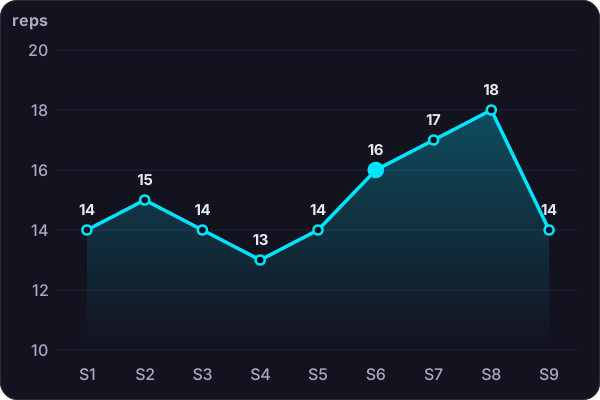
| S6 | 85 kg: 6, 5, 5 | 16 | Rest 90 s to 3 min, rep target stays 6 |
| S7 | 85 kg: 6, 6, 5 | 17 | Nothing |
| S8 | 85 kg: 6, 6, 6 | 18 | Nothing |
| S9 | 87.5 kg: 5, 5, 4 | 14 | 87.5 kg (193 lb), up 2.5 kg |
At S8 every set hit 6 reps, which by Epley is an estimated 1RM of 102.0 kg (225 lb), up from 99.2 kg. That is the signal to add weight. The reps drop to 14 at S9 and the climb starts again.
Coach's tip: Change one thing per block. If you lengthen rest, add a set and swap the exercise in the same week, the log cannot tell you which one worked.
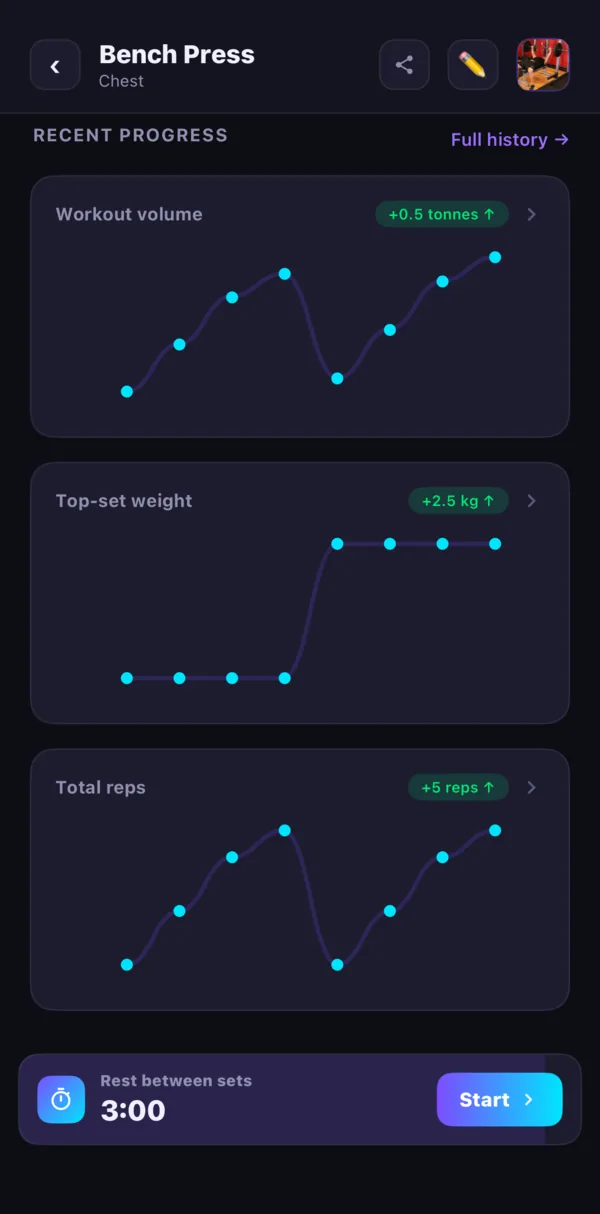
Each exercise keeps a full history, and Analytics → Strength & PRs charts an automatic Est. 1RM trend for your lifts once you have a few sessions (see how often to retest a max). A flat line on one chart next to a rising line on another tells you which lever to pull.
A deload week is the last lever, not the first
A deload is a planned stretch of lighter training. A 2023 Delphi panel of expert coaches (34 began, 21 finished) defined a deload as a period of reduced training stress. Its aim is to ease fatigue and prepare you for later training (Bell et al.). That is expert opinion, not a trial result.
The one trial cited here is less encouraging. In 39 resistance-trained adults, a full week away from the gym at the midpoint of a 9-week program made no difference to muscle growth. The group that trained straight through gained more lower-body strength (Coleman et al., 2024). Two of the authors have ties to fitness companies, which the paper discloses.
That study tested a week with no lifting, not a week of lighter lifting. A reasonable approach, not a trial result: keep a deload for when fatigue is piling up across several lifts. For one stuck lift, the changes above come first.
Common mistake: Swapping exercises every week to keep muscles guessing. A 2022 review in young men found that excessive, random variation may compromise gains (Kassiano et al.). Plan any change, and log it.
How to break a strength plateau: the order to try
- Confirm the stall. Three sessions, no new weight, rep or total reps.
- Read the three numbers. Top-set weight, total reps and estimated 1RM.
- Push reps at the same weight. Add weight only when every set reaches the top of your range.
- Then rest longer or add a set. One change per block, logged.
- Deload only if fatigue is the pattern. If a lift hurts, see a qualified professional.
The volume side of this is covered in how to calculate training volume. It also explains why a week can feel harder while the tonnage falls.