How to Calculate Training Volume: Tonnage, Reps and Sets
To calculate training volume, multiply sets × reps × weight for each exercise, then add the results. One week of six lifts comes to 11,010 kg (24,273 lb) of volume load, 156 reps and 19 sets. Which one to track depends on your question: more work on a lift, more reps at one weight, or enough sets per muscle.
On this page
How to calculate training volume: sets × reps × weight
Volume load, also called tonnage, is the easiest of the three to compute. For one exercise, 3 sets of 8 reps at 80 kg is 3 × 8 × 80 = 1,920 kg (4,233 lb). Do that for every exercise, then add the rows.
Here is a full week for one lifter, three sessions of two lifts each. Only working sets are counted.
| Day | Exercise | Sets × reps @ weight | Reps | Volume load |
|---|---|---|---|---|
| Mon | Bench press | 3 × 8 @ 80 kg | 24 | 1,920 kg |
| Mon | Overhead press | 3 × 10 @ 40 kg | 30 | 1,200 kg |
| Wed | Squat | 4 × 6 @ 100 kg | 24 | 2,400 kg |
| Wed | Romanian deadlift | 3 × 8 @ 90 kg | 24 | 2,160 kg |
| Fri | Barbell row | 3 × 8 @ 70 kg | 24 | 1,680 kg |
| Fri | Lat pulldown | 3 × 10 @ 55 kg | 30 | 1,650 kg |
| Week | 19 sets | 156 | 11,010 kg |
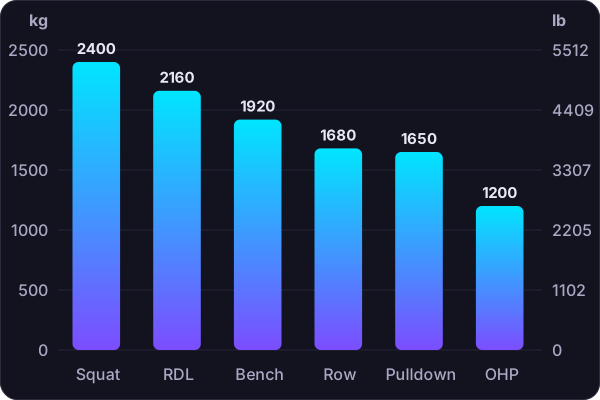
In pounds, multiply the plate weights you actually lifted. Don't convert a kg total to lb and back, or the rounding drifts.
Total reps and weekly sets are the other two numbers
The same table holds two more measures, and they answer different questions.
- Total reps ignore the weight. Here that's 156 for the week. They are handy when the weight stays put and you are adding reps, as in double progression.
- Sets per muscle per week ignore reps and weight. This is the number muscle-growth studies tend to count, and the one that changes most between versions of a push pull legs split.
To get sets per muscle, assign each exercise to the muscle it mainly trains and add its sets. The guide on how many sets per muscle group per week shows what the studies found. This week comes out as:
| Muscle group | Exercises | Sets per week |
|---|---|---|
| Back | Barbell row, lat pulldown | 6 |
| Quads | Squat | 4 |
| Chest | Bench press | 3 |
| Shoulders | Overhead press | 3 |
| Hamstrings | Romanian deadlift | 3 |
The groups add up to the same 19 sets. Counting rules differ between studies. The 2026 meta-regression below counted indirect sets, such as a bench press for the triceps, as half a set. This table gives each exercise to one muscle, the simpler rule you can use by hand.
Common mistake: Counting warm-up sets. A bar-only set at 20 kg adds almost nothing to the tonnage but one full set to your count. Log working sets only.
Which number to track for strength or muscle
None of the three is the right one for everybody. Pick by the question you are asking.
| You want to know | Track | Why |
|---|---|---|
| Am I doing more work on this lift than last month? | Volume load for that exercise | It rises when weight, reps or sets rise |
| Am I adding reps at a fixed weight? | Total reps | The weight cancels out |
| Do I train each muscle enough? | Weekly sets per muscle | Studies link more weekly sets per muscle to more growth; they don't set a number |
The research on the last row comes with limits. A 2017 meta-analysis of 15 studies linked more weekly sets per muscle to more muscle growth, about 0.37% extra for each added set, and it counted sets, not tonnage.
A 2026 meta-regression of 67 studies found more sets kept paying off, but each extra set added less, especially for strength.
For tonnage, a 2016 review of resistance training monitoring describes volume load as a practical way to quantify a session. It also says there isn't yet a consensus on how best to monitor training. Keep in mind that volume load does not capture how close a set was to failure, or how long you rested.
Tonnage can fall in a week that got harder
Volume load is a total, so a heavier week can score lower. Say the bench press moves from 3 × 8 @ 80 kg to 3 × 5 @ 90 kg.
| Bench press | Top-set weight | Reps | Volume load |
|---|---|---|---|
| Before: 3 × 8 @ 80 kg | 80 kg (176 lb) | 24 | 1,920 kg |
| After: 3 × 5 @ 90 kg | 90 kg (198 lb) | 15 | 1,350 kg |
Tonnage fell by 570 kg (1,257 lb) while the top set got 10 kg (22 lb) heavier. Nothing went wrong. You traded reps for load. The same thing happens in the week after a weight jump, which is why tracking progressive overload looks at top-set weight, reps and volume together.
Coach's tip: Compare a lift with its own past weeks, never with another lift. In the table above, the squat's 2,400 kg and the lat pulldown's 1,650 kg don't tell you which muscle worked harder.
How to total your volume each week
- Log working sets only. Weight and reps for each, as you do them. The workout logging guide covers what to write down.
- Multiply each row. Sets × reps × weight, or weight × reps for each set if the sets differ.
- Add by exercise first, then by week. Exercise totals show where the work went. The week total shows the trend.
- Compare the same week of the cycle. This Monday against last Monday, not against a deload.
A spreadsheet can do the multiplying. The workout tracker spreadsheet guide has the SUMIFS formula for a weekly total.
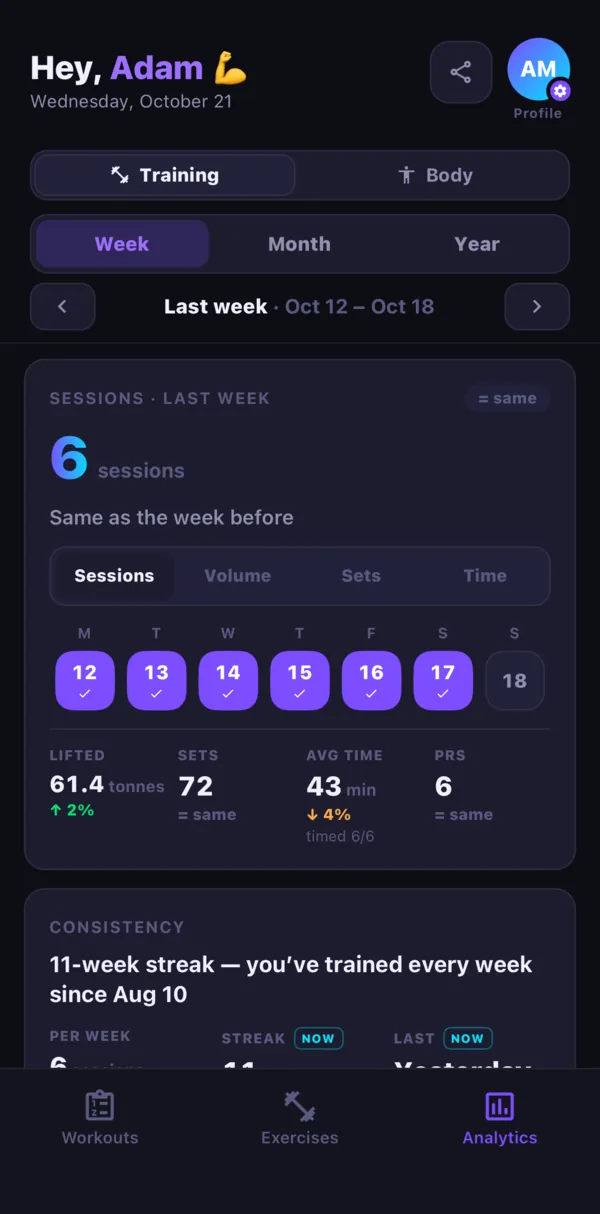
Lifter Log does the adding for you. Its Analytics tab has an overview chart of sessions, volume, sets and time, and you swipe to change the period between week, month and year.
Muscle balance counts your sets per muscle group, giving each exercise to one group, as in the table above. Each exercise also has its own charts of top-set weight and total reps.