How Long to Rest Between Sets for Muscle and Strength
ACSM's guideline: rest at least 2–3 minutes between heavy sets of big lifts like the squat and bench press. On smaller exercises, 1–2 minutes may be enough. For muscle growth, a 2024 meta-analysis suggests over 60 seconds, with no clear extra gain past 90. Whatever you pick, rest the same each session so your reps stay comparable.
On this page
How long to rest between sets, by lift and goal
Two things set your rest: how heavy the set is and what you're training for. Heavy sets of big lifts need the longest breaks. Light single-joint work needs the shortest.
| What you're doing | Rest | Source |
|---|---|---|
| Heavy sets of big lifts like the squat and bench press | At least 2–3 min | ACSM guideline, 2009 |
| Heavy low-rep sets of 1–6, after 6+ months of training | 3–5 min | ACSM guideline, 2009 |
| Assistance exercises, like curls and raises | 1–2 min may be enough | ACSM guideline, 2009 |
| Sets for muscle growth | Over 60 s may help; little change past 90 s | Singer et al., 2024 |
| Strength, if you're new to lifting | 60–120 s seems enough | Grgic et al., 2018 |
| Strength, if you're trained | Over 2 min seems needed for the most gain | Grgic et al., 2018 |
The rows overlap. ACSM's muscle-growth advice shows how they combine: 1–2 minutes for novice and intermediate lifters. For advanced lifters, 2–3 minutes may be used on heavy core lifts and 1–2 minutes on the rest. When in doubt, give the big lift the longer rest.
Common mistake: treating 3–5 minutes as the rule for everything. ACSM gives that range for heavy sets of 1–6 reps. For a set of 12 curls, it says 1–2 minutes may be enough.
About 90 seconds for muscle, longer for trained strength
For muscle growth: past 90 seconds adds little
The newest summary is a 2024 meta-analysis of 9 studies on rest and muscle size. The results suggest a small edge for resting longer than 60 seconds. Past about 90 seconds, it found no appreciable difference (Singer et al., 2024). The results overlapped a lot, so treat 60 to 90 seconds as a rough line.
The authors suggest a reason: short rests may cut the total weight you lift across your sets, and that cost tends to level off past 90 seconds.
One trial in trained lifters fits that picture. Twenty-one trained men rested either 1 or 3 minutes between sets for 8 weeks. The 3-minute group gained more squat and bench strength and more thigh muscle. The arm differences weren't significant (Schoenfeld et al., 2016).
For strength: trained lifters seem to need over 2 minutes
A review of 23 studies looked at rest and strength gains. In trained lifters, rests longer than 2 minutes seemed needed to get the most strength. In untrained people, 60–120 seconds seemed enough (Grgic et al., 2018).
The same review found solid strength gains even with rests under 60 seconds. So short rests can still build strength when time is tight. If you're a trained lifter and strength is the goal, the longer rests are where the review saw the most gain.
Shorter rest costs reps on your later sets
Rest shows up first in your log. In one study, 15 college-aged men did 4 sets of squat and bench at their 8-rep max. They rested 1, 2 or 5 minutes. The 5-minute rests gave the most total reps, then 2 minutes, then 1 (Willardson and Burkett, 2005).
Here is how that looks in a log. These numbers are an example, not the study's data. Same lifter, same 80 kg (176 lb) bench press, three rest times:
| Rest | Reps per set | Total reps |
|---|---|---|
| 1 min | 8, 6, 5, 4 | 23 |
| 2 min | 8, 7, 7, 6 | 28 |
| 3 min | 8, 8, 7, 7 | 30 |
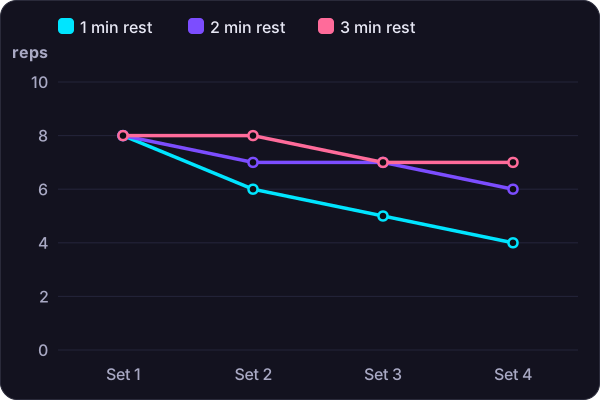
Set 1 is the same in all three. The gap opens on sets 2 to 4, and the shortest rest loses the most.
Now picture those as three Mondays in a row. The log reads 23, then 28, then 30 reps. It looks like progress, but the lifter only changed the clock. A change in rest can fake progress in your log, or hide it.
This matters most if you run double progression, where the reps decide when the weight goes up. A longer rest one week can earn a jump your strength hasn't.
Keep each lift's rest the same, session to session
Progressive overload means beating last time, and that only works if last time was measured the same way. Pick a rest for each exercise and treat it like your grip or your depth: fixed.
- Pick one rest per exercise. Use the table above. For example, 3 minutes for squats, 2 for rows and 90 seconds for curls.
- Start the timer when you put the weight down. Start the next set when it runs out.
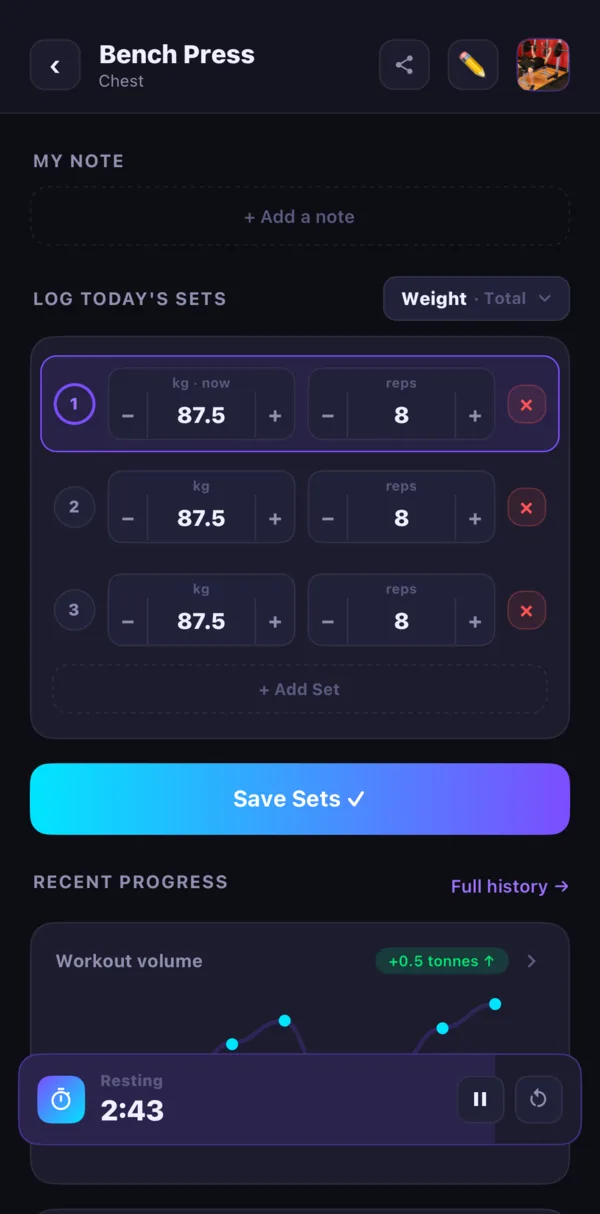
- Log the set while you rest. You're waiting anyway, so write down the weight and reps before you forget them.
- Change rest on purpose, and change nothing else that day. If you lengthen a rest, expect a few more reps. Don't count them as a strength gain.
- Note it when a rest runs long. A queue for the rack or a phone call happens. A short note explains an odd set later.
Test your own rest time in two sessions
The table gives ranges. To find where you sit on one lift, run this check. It's a rule of thumb, not a study protocol.
- Pick one lift and fix the weight. Use a weight you can lift for your target reps on the first set.
- Session A: your usual rest. Log the reps for every set.
- Session B: add 60 seconds. Same lift, same weight, same number of sets, the next time you train it.
- Compare the last two sets. That's where rest shows up.
Quick check: if session B gave 2 or more extra reps across the last two sets, keep the longer rest for that lift. If it gave 0 or 1, your shorter rest is enough. One rep can just be a better day.
The example log shows both outcomes. Going from 1 to 2 minutes added 4 reps on sets 3 and 4 (9 to 13), so the longer rest earns its time. Going from 2 to 3 minutes added 1 (13 to 14), so 2 minutes is enough for that lifter on that lift.
Run the check on your main lifts only. For curls and raises, the guideline's 1–2 minutes is a fine place to start.
Rest between exercises: give the next lift its own rest
Rest between sets gets the research, but a session has other gaps too. These rules keep them from eating your time or your reps:
- Between exercises: give the next exercise the rest its own sets get. After squats, leg curls need only a leg curl's rest. After curls, a heavy bench press needs its full rest, plus time for warm-up sets.
- Supersets: two exercises back to back, then rest. Pair moves that use different muscles, like a row and a press, so one rests while the other works. After the pair, take the rest the harder exercise needs.
- Warm-up sets: short breaks are fine. Keep strict rest for working sets, because those are the sets you compare.
- Short on time: cut rest on assistance work first and keep the full rest on your big lifts.
When you change a session's order or pairings, the reps on the moved exercises can change too. Log them as they are and give the new layout a couple of sessions before you judge it.