How to Start Strength Training: Your First Month
To start strength training, lift three non-consecutive days a week, alternating two short full-body workouts of three exercises each. Start with weights you could lift about 15 times, aim for 10 clean reps, and add weight only once you beat that target by a rep or two. The American College of Sports Medicine recommends 2–3 days a week for novices.
On this page
How to start strength training: three full-body days
Train Monday, Wednesday and Friday, or any three days with a rest day between them. Alternate two workouts, A and B, so you do A, B, A one week and B, A, B the next. Each one has three exercises.
| Workout A | Workout B |
|---|---|
| Goblet squat or barbell squat | Romanian deadlift |
| Bench press (dumbbell or barbell) | Overhead press |
| Seated cable row | Lat pulldown |
Do 3 sets of about 10 reps on each. Each workout starts with the big, multi-joint lifts, as the ACSM position stand suggests. The exact lifts and the 3 × 10 are this guide's working rule, not a prescription from a study. Swap in a machine or a dumbbell version if your gym lacks one.
Decide the three days now, not on the day. A meta-analysis of 26 studies found that if-then planning of when you will exercise gave a small-to-medium boost to physical activity. It measured activity in general, not lifting.
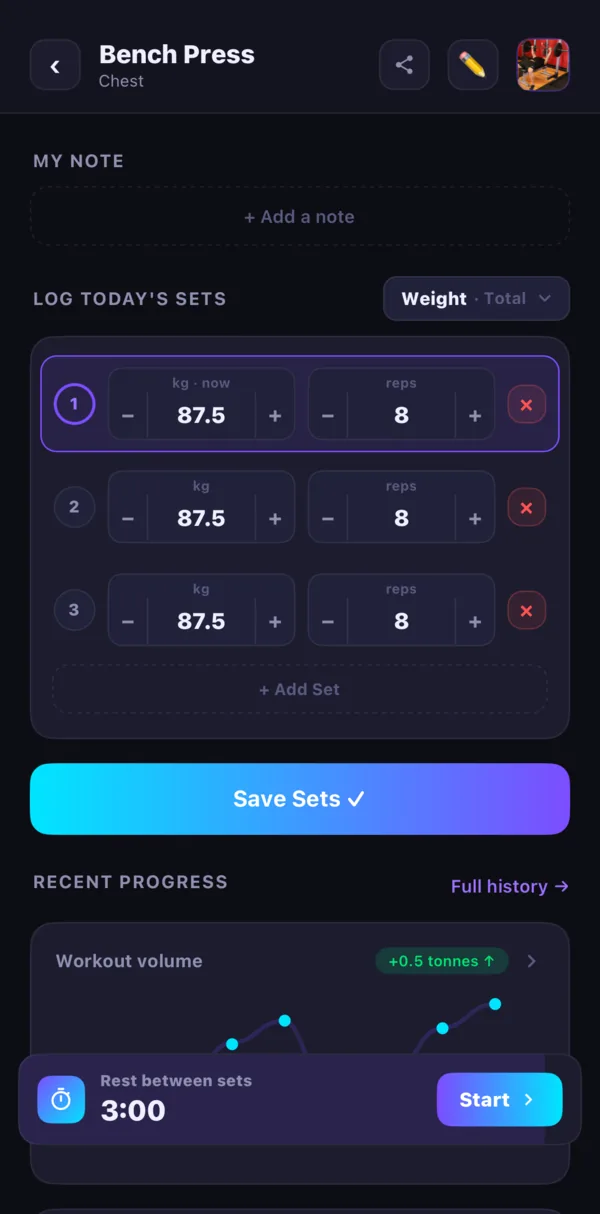
A new Lifter Log account with no workouts offers a one-tap sample workout with bench, squat, deadlift and overhead press. It is a quick start, not a coached program, so the plan above is still yours to follow.
Quick check: Sharp pain, joint pain or a health condition you are unsure about is a reason to see a qualified professional before you carry on.
Find your starting weight in the first session
You do not need a test. Use the first session to find a weight that is easy to lift well, then build from there. The ACSM position stand recommends loads in an 8–12 repetition-maximum range for novices, meaning a weight you could lift about 8–12 times before you could not lift it again.
- Start light. For the bench press, an empty 20 kg barbell (44 lb) is a fine first set. For a squat or row, begin with a weight you could lift for 15 reps.
- Add weight each set. Move up in small steps until 10 clean reps feels hard. Your loads then sit near the ACSM range as you add weight.
- Write it down. Log the weight and reps of every set. That is next session's target.
This ramp-up is a working rule, not a study result. Expect the first week to feel easy. You are learning the movements, and the logged weight is only a starting point.
Common mistake: Opening with a guess at what you can lift. A first set that is too heavy costs you form, so start light and work up. If the barbell is new to you, how to load a barbell walks through the plates.
Add weight when you beat the target by 1–2 reps
When you can do your target for one or two reps more, add weight. The ACSM position stand is a guideline, not a trial result: at a set repetition-maximum load, when you can do one to two reps over your target, raise the load by 2–10%. For a 30 kg bench press, that is 0.6 to 3 kg. A pair of 1.25 kg plates (2.5 kg in total) fits, if your gym has them.
Say your target is 10 reps on all 3 sets. Our working rule, one rep over the target, is to add 2.5 kg next session once every set reaches 11. That is 8.3% on 30 kg, inside the ACSM range. If only one set reaches 11, keep the weight. This is a simple form of double progression, and tracking progressive overload explains the wider idea.
Adding reps counts as progress too. In one 8-week trial of trained lifters, adding reps at the same weight built leg muscle about as well as adding weight. In that study of 43 people, which covered legs only, Smith-machine squat 1RM slightly favored the load group (+2.0 kg, of questionable practical significance).
A worked first month: bench press in six sessions
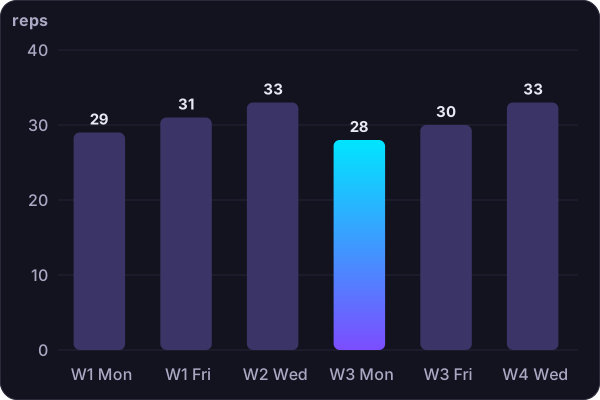
Here is what four weeks looks like for a beginner who benches in Workout A. It uses a 20 kg barbell, a target of 10 reps for 3 sets and the rule above. The numbers are an example, not data from a study.
| Session | Weight | Reps per set | Total reps | Next time |
|---|---|---|---|---|
| Week 1, Monday | 30 kg (66 lb) | 10, 10, 9 | 29 | Keep 30 kg |
| Week 1, Friday | 30 kg | 11, 10, 10 | 31 | Keep 30 kg |
| Week 2, Wednesday | 30 kg | 11, 11, 11 | 33 | Add 2.5 kg |
| Week 3, Monday | 32.5 kg (72 lb) | 10, 9, 9 | 28 | Keep 32.5 kg |
| Week 3, Friday | 32.5 kg | 10, 10, 10 | 30 | Keep 32.5 kg |
| Week 4, Wednesday | 32.5 kg | 11, 11, 11 | 33 | Add 2.5 kg (35 kg, 77 lb) |
The weight sat at 30 kg for three sessions, yet total reps rose from 29 to 33. That is progress, and a log shows it where a glance at the bar does not. In this made-up log, reps dip to 28 after the jump and are back at 33 two sessions later.
Over the month the bench went up 2.5 kg, from 30 to 32.5 kg (66 to 72 lb), and the next session is set for 35 kg (77 lb). The other five lifts work the same way. If you want to know how to record each set, how to log workouts covers the format.
A sample plan for your first 10 weeks
In one narrative review, 10 weeks of resistance training may increase lean weight by 1.4 kg and reduce fat weight by 1.8 kg in inactive adults. By our own subtraction that is about 0.4 kg lost, so the scale may barely move. The review is a summary, not a guarantee.
Better signs come from your own numbers: the weight on the bar, the reps per set, and a tape measure if you want to track your body. How to track body measurements shows how.
- Weeks 1–2: learn the six lifts. Find a starting weight for each in its first session.
- Weeks 3–4: add weight once every set reaches 11, as in the example above.
- Weeks 5–10: keep the three days and keep the log going.
Once that routine feels easy and progress slows, read how to break a strength plateau. For the time between sets, how long to rest between sets sets out what the guidelines and trials say.