How Often Should You Test Your 1RM? Wait for a 5% Gain
How often should you test your 1RM? As a working rule (ours, not a published guideline), no more often than every 8 to 12 weeks, and only when a number needs it. Retests of the same lift vary by about 3 to 4% on their own, around 3 kg on a 100 kg bench, so wait for a bigger gain.
On this page
How often should you test your 1RM? Wait for a 5% gain
The research here measures how repeatable the test is, not how often to repeat it.
A 2020 systematic review of 32 studies (1,595 people) found the test reliable, with a median intraclass correlation of 0.97 (Grgic et al., 2020). It also reports the day-to-day spread: a coefficient of variation of 0.5 to 12.1%, median 4.2%. For people with some training experience the median was 3.3%.
That spread sets the interval. If a test can read 3 kg off with no change in strength, a retest has to beat that before it tells you anything.
Two tests compound the spread. Our arithmetic: 3.3% × 1.41 is about 4.7%, roughly one standard deviation of the gap between two tests. As a rule of thumb, treat a change under about 5% as unproven, and a much larger one as more likely real.
This treats the review's spread as the error of one test. With no real change, a bell curve would still show +5% or more about one time in seven.
Take a bench press, with kg first and lb in brackets:
- Test 1: 100 kg (220 lb).
- Test 2, eight weeks later: 102.5 kg (226 lb). That is +2.5%, inside the wobble. You may be stronger, or it was a good day. Gains don't arrive in a straight line, so the readings need not fit one pace.
- Test 3, sixteen weeks after test 1: 107.5 kg (237 lb). That is +7.5%, past 5 kg (11 lb), so it is more likely a real gain than noise.
The 8 to 12 weeks in the title is our working rule, not a published guideline. It follows from the gain you expect, as the next section shows.
How many weeks until a gain beats the wobble
Divide 5% by your gain per 4 weeks, then multiply by 4. If your lift rises 2% every 4 weeks, you need 10 weeks to pass 5%.
| Gain per 4 weeks | Weeks to reach 5% | On a 100 kg lift |
|---|---|---|
| 1% | 20 | +1 kg (2.2 lb) a month |
| 2% | 10 | +2 kg (4.4 lb) a month |
| 2.5% | 8 | +2.5 kg (5.5 lb) a month |
| 3% | 6.7 | +3 kg (6.6 lb) a month |
| 5% | 4 | +5 kg (11 lb) a month |
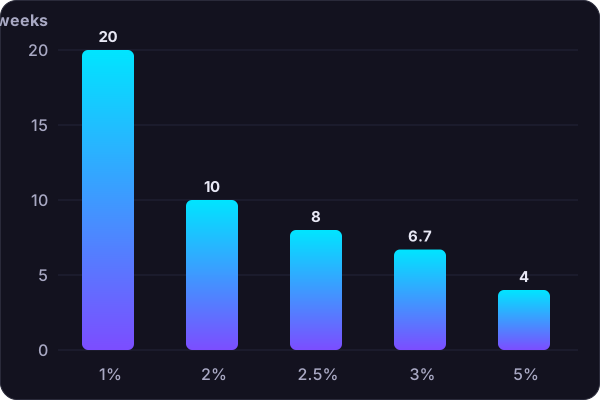
Lifters who add 2 to 2.5 kg a month to a 100 kg lift land on the 8 to 10 week rows. Slower gains push the wait toward 20 weeks, so a test every 8 weeks would mostly read noise.
Gains usually slow as you get stronger, so the interval tends to stretch over the years. See how to break a strength plateau when the line goes flat.
Between tests, estimate your max from hard sets
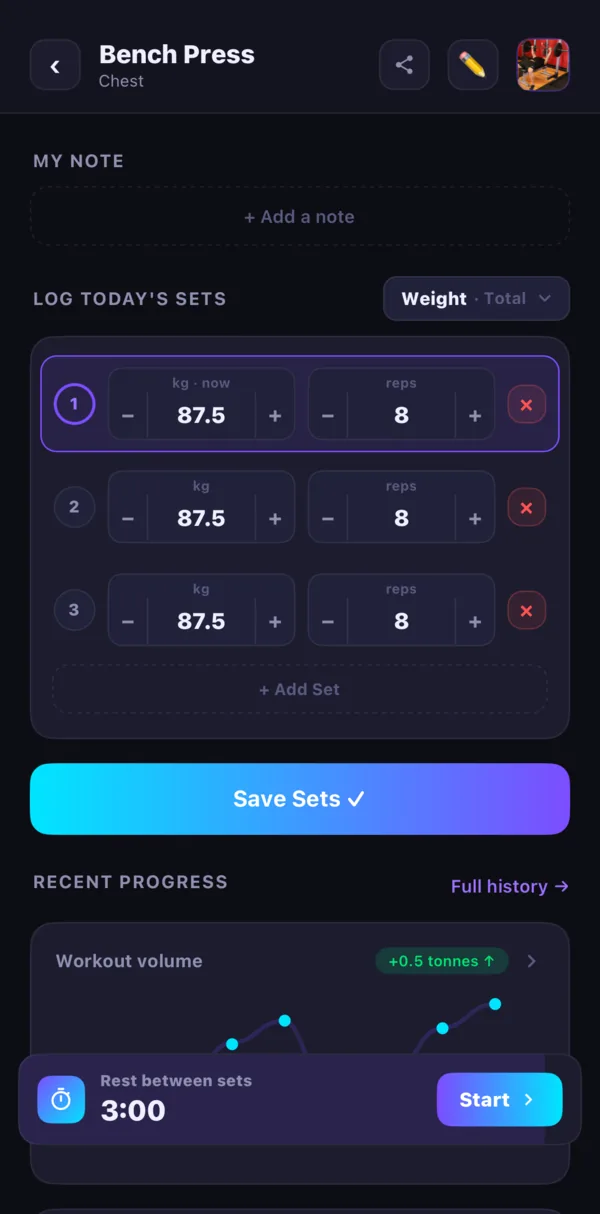
You don't need a test to see a trend. Any hard set of up to 10 reps carries an estimate. The Epley formula is weight × (1 + reps ÷ 30), so 87.5 kg × 8 gives about 110.8 kg (244 lb). The 1RM calculator does the math, and the 1RM percentage chart shows how far reps at each percentage vary.
| Week | Best set | Estimated 1RM |
|---|---|---|
| 0 | 82.5 kg × 8 (182 lb) | 104.5 kg (230 lb) |
| 4 | 85 kg × 8 (187 lb) | 107.7 kg (237 lb) |
| 8 | 87.5 kg × 8 (193 lb) | 110.8 kg (244 lb) |
Each point comes from a normal working set, so it costs no extra session. The line rose 6.3 kg in 8 weeks with no max attempt.
Estimates have their own error, though. In a 2024 meta-analysis, reps at 80% of max had a standard deviation of about 2.5 reps between people (Nuzzo et al., 2024). So compare a lift with its own earlier numbers, not across lifts, and read the line rather than one point.
How to run the test when one is due
- Use the same lift as last time. A paused bench and a touch-and-go bench are different lifts with different maxes.
- Test fresh. Our working rule: after a rest day, not after a leg session that tires the same muscles.
- Warm up in steps. One study the review lists (Scott et al.) used 10 reps near 50%, 5 near 70%, then a single near 90% of the expected max.
- Take a few single attempts. The studies in the review allowed 3 to 8 attempts, with 1 to 5 minutes of rest between them. Our rule: add weight each time and stop at the first miss.
- Use a spotter or safety bars. Count only reps with good form.
- Log it like any set. Note the date, so the next gap is easy to count.
Common mistake: reading a 2 kg drop as lost strength. A change under about 5% is probably inside the wobble, so keep the plan and retest on the planned date.
The review's authors say the test seems generally safe, with few adverse events, mostly muscle soreness. Pain or an old injury is a reason to see a qualified professional first.
When to skip the test and keep logging
- Nothing in your plan uses a percentage of your max. Then a test changes no decision. Double progression needs only last session's weight and reps.
- You are new to the lift. The review describes a study (Ploutz-Snyder and Giamis) where untrained people needed up to eight sessions to settle. That study saw an average rise of 13 kg from first to last session. Early "gains" may be partly practice.
- Your max is stale and a program needs it. Use one hard set to check it first, as in the percentage chart guide.
- You want proof you're getting stronger. The estimated trend and your progressive overload log show it without a max attempt. The Est. 1RM sits in the app's Analytics tab.
When a number does need a real test, wait until the table says your gain can beat 5%, then run it the way the steps above describe.